
karenl7 _at_ stanford _dot_ edu
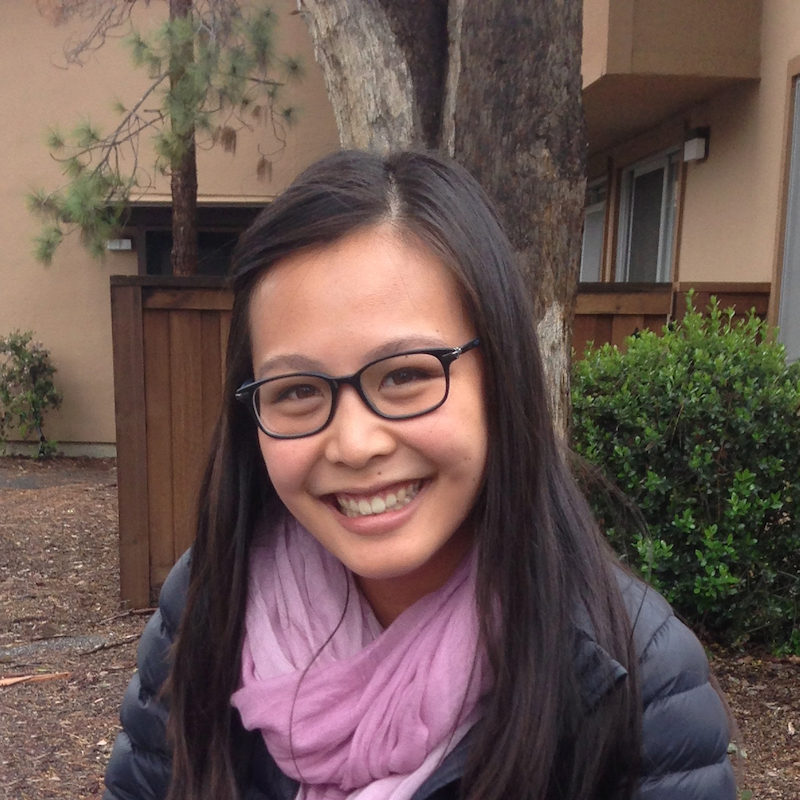
Karen Leung
Alumni · now at University of Washington (via NVIDIA Research)
Karen Leung is a Ph.D. candidate in the Aeronautics & Astronautics department, where she also received her Master's degree in 2017. Prior to her studies at Stanford, Karen graduated from the University of Sydney with a Bachelor of Engineering and Bachelor of Science with First Class Honors in 2014, majoring in Aeronautical (Space) and Mathematics (Advanced). She also held a summer internship at Toyota Research Institute.
The goal of her research is to harness the advances in learning-empowered robot autonomy and unite them with the assurances provided by formal methods to develop powerful yet safe and trustworthy autonomous systems. Her research draws upon techniques from control theory, robot motion planning, optimization, formal methods and verification, and machine learning.
Previously, she worked on control contraction analysis for nonlinear dynamical systems with the Australian Center for Field Robotics, and also on Hamiltonian and Lagrangian dynamics for platform diving funded by the Australian Institute of Sport.
Awards:
- Robert H. Cannon Jr. Fellowship (2018)
- Qualcomm Innovation Fellowship (2018)
- Eleanor Sophia Wood Postgraduate Research Traveling Scholarship (2016-2017)
- Arcus Travelling Scholarship (2015-2016)
Publications
14 publications · full lab bibliography
- K. Leung and M. Pavone, “Semi-Supervised Trajectory-Feedback Controller Synthesis with Signal Temporal Logic Specifications,” American Control Conference, 2022.
- K. Leung, “On Using Formal Methods for Safe and Robust Robot Autonomy,” Ph.D. dissertation, Stanford University, Dept. of Aeronautics and Astronautics, 2021.
- S. Schaefer, K. Leung, B. Ivanovic, and M. Pavone, “Leveraging Neural Network Gradients within Trajectory Optimization for Proactive Human-Robot Interactions,” Proc. IEEE Conf. on Robotics and Automation, 2021.
- B. Ivanovic, K. Leung, E. Schmerling, and M. Pavone, “Multimodal Deep Generative Models for Trajectory Prediction: A Conditional Variational Autoencoder Approach,” IEEE Robotics and Automation Letters, vol. 6, no. 2, pp. 295--302, 2021.
- K. Leung, N. Aréchiga, and M. Pavone, “Back-propagation through signal temporal logic specifications: Infusing logical structure into gradient-based methods,” Workshop on Algorithmic Foundations of Robotics, 2020.
- X. Wang, K. Leung, and M. Pavone, “Infusing Reachability-Based Safety into Planning and Control for Multi-agent Interactions,” IEEE/RSJ Int. Conf. on Intelligent Robots & Systems, 2020.
- J. DeCastro, K. Leung, N. Aréchiga, and M. Pavone, “Interpretable Policies from Formally-Specified Temporal Properties,” Proc. IEEE Int. Conf. on Intelligent Transportation Systems, 2020.
- K. Leung, E. Schmerling, M. Zhang, M. Chen, J. Talbot, J. C. Gerdes, and M. Pavone, “On Infusing Reachability-Based Safety Assurance within Planning Frameworks for Human-Robot Vehicle Interactions,” Int. Journal of Robotics Research, vol. 39, no. 10--11, pp. 1326--1345, 2020.
- B. Ivanovic, E. Schmerling, K. Leung, and M. Pavone, “Generative Modeling of Multimodal Multi-Human Behavior,” IEEE/RSJ Int. Conf. on Intelligent Robots & Systems, 2018.
- E. Schmerling, K. Leung, W. Vollprecht, and M. Pavone, “Multimodal Probabilistic Model-Based Planning for Human-Robot Interaction,” Proc. IEEE Conf. on Robotics and Automation, 2018.
- K. Leung, E. Schmerling, M. Chen, J. Talbot, J. C. Gerdes, and M. Pavone, “On Infusing Reachability-Based Safety Assurance within Probabilistic Planning Frameworks for Human-Robot Vehicle Interactions,” Int. Symp. on Experimental Robotics, 2018.