
Jacky Kwok

Contacts:

Email: jackyk02 at stanford dot edu

Jacky Kwok


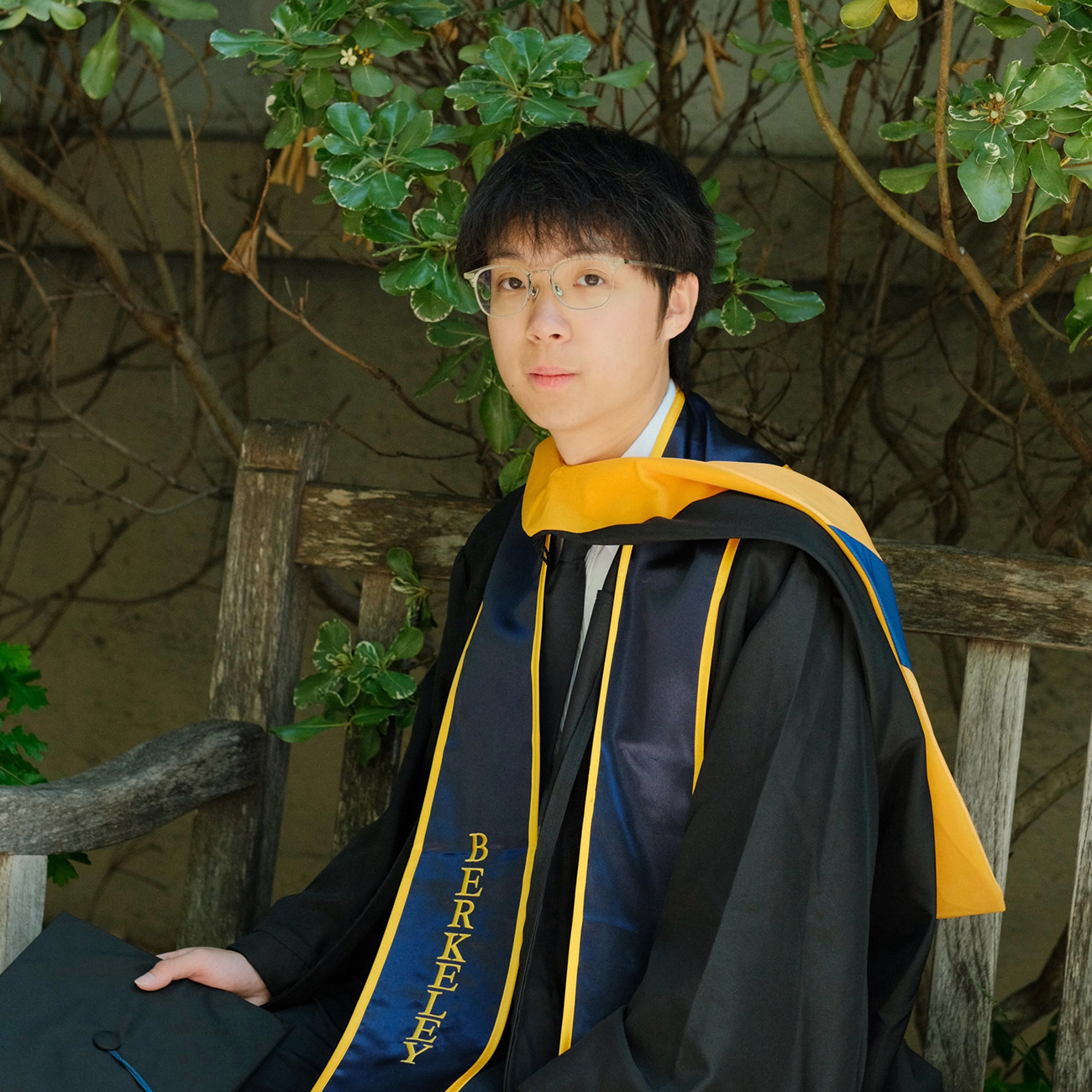
Jacky is a PhD student in the Department of Computer Science at Stanford University, advised by Professors Marco Pavone and Azalia Mirhoseini. His research lies at the intersection of machine learning, systems, and robotics, with a particular focus on test-time scaling and foundation models for robotics. He is part of the Autonomous Systems Lab and the Scaling Intelligence Lab.

Before joining Stanford, Jacky received his Bachelor’s and Master’s degrees in Computer Science at UC Berkeley, where he conducted research at the Sky Computing Lab, Berkeley AI Research (BAIR) Lab, and iCyPhy Center. His master’s thesis focused on developing efficient and reliable systems for reinforcement learning and robotics under the guidance of Professors Ion Stoica and Edward Ashford Lee. Outside of research, he enjoys playing tennis, going to concerts, and skiing.


ASL Publications

  1. J. Kwok, X. Zhang, M. Xu, Y. Liu, A. Mirhoseini, C. Finn, and M. Pavone, “Scaling Verification Can Be More Effective than Scaling Policy Learning for Vision-Language-Action Alignment,” 2026. (Submitted)

    Abstract: The long-standing vision of general-purpose robots hinges on their ability to understand and act upon natural language instructions. Vision-Language-Action (VLA) models have made remarkable progress toward this goal, yet their generated actions can still misalign with the given instructions. In this paper, we investigate test-time verification as a means to shrink the "intention-action gap." We first characterize the test-time scaling laws for embodied instruction following and demonstrate that jointly scaling the number of rephrased instructions and generated actions greatly increases test-time sample diversity, often recovering correct actions more efficiently than scaling each dimension independently. To capitalize on these scaling laws, we present CoVer, a contrastive verifier for vision-language-action alignment, and show that our architecture scales gracefully with additional computational resources and data. We then introduce CoVer-VLA, a hierarchical test-time verification pipeline using the trained verifier. At deployment, our framework precomputes a diverse set of rephrased instructions from a Vision-Language-Model (VLM), repeatedly generates action candidates for each instruction, and then uses the verifier to select the optimal high-level prompt and low-level action chunks. Compared to scaling policy pre-training on the same data, our verification approach yields 22% gains in-distribution and 13% out-of-distribution on the SIMPLER benchmark, with a further 45% improvement in real-world experiments. On the PolaRiS benchmark, CoVer-VLA achieves 14% gains in task progress and 9% in success rate.

    @article{KwokZhangEtAl2026,
      author = {Kwok, J. and Zhang, X. and Xu, M. and Liu, Y. and Mirhoseini, A. and Finn, C. and Pavone, M.},
      title = {Scaling Verification Can Be More Effective than Scaling Policy Learning for Vision-Language-Action Alignment},
      year = {2026},
      keywords = {sub},
      owner = {kwok},
      timestamp = {2026-02-12},
      url = {https://arxiv.org/abs/2602.12281}
    }
    
  2. J. Kwok, C. Agia, R. Sinha, M. Foutter, S. Li, I. Stoica, A. Mirhoseini, and M. Pavone, “RoboMonkey: Scaling Test-Time Sampling and Verification for Vision-Language-Action Models,” in Conf. on Robot Learning, Seoul, Korea, 2025. (In Press)

    Abstract: Vision-Language-Action (VLA) models have demonstrated remarkable capabilities in visuomotor control, yet ensuring their robustness in unstructured real-world environments remains a persistent challenge. In this paper, we investigate test-time scaling through the lens of sampling and verification as means to enhance the robustness and generalization of VLAs. We first demonstrate that the relationship between action error and the number of generated samples follows an exponentiated power law across a range of VLAs, indicating the existence of inference-time scaling laws. Building on these insights, we introduce RoboMonkey, a test-time scaling framework for VLAs. At deployment, RoboMonkey samples a small set of actions from a VLA, applies Gaussian perturbation and majority voting to construct an action proposal distribution, and then uses a Vision Language Model (VLM)-based verifier to select the optimal action. We propose a synthetic data generation pipeline for training such VLM-based action verifiers, and demonstrate that scaling the synthetic dataset consistently improves verification and downstream accuracy. Through extensive simulated and hardware experiments, we show that pairing existing VLAs with RoboMonkey yields significant performance gains, achieving a 25% absolute improvement on out-of-distribution tasks and 9% on in-distribution tasks. Additionally, when adapting to new robot setups, we show that fine-tuning both VLAs and action verifiers yields a 7% performance increase compared to fine-tuning VLAs alone.

    @inproceedings{KwokAgiaEtAl2025,
      author = {Kwok, J. and Agia, C. and Sinha, R. and Foutter, M. and Li, S. and Stoica, I. and Mirhoseini, A. and Pavone, M.},
      title = {RoboMonkey: Scaling Test-Time Sampling and Verification for Vision-Language-Action Models},
      booktitle = {{Conf. on Robot Learning}},
      year = {2025},
      month = jul,
      address = {Seoul, Korea},
      keywords = {press},
      note = {In press},
      owner = {kwok},
      timestamp = {2025-07-07},
      url = {https://arxiv.org/abs/2506.17811}
    }