
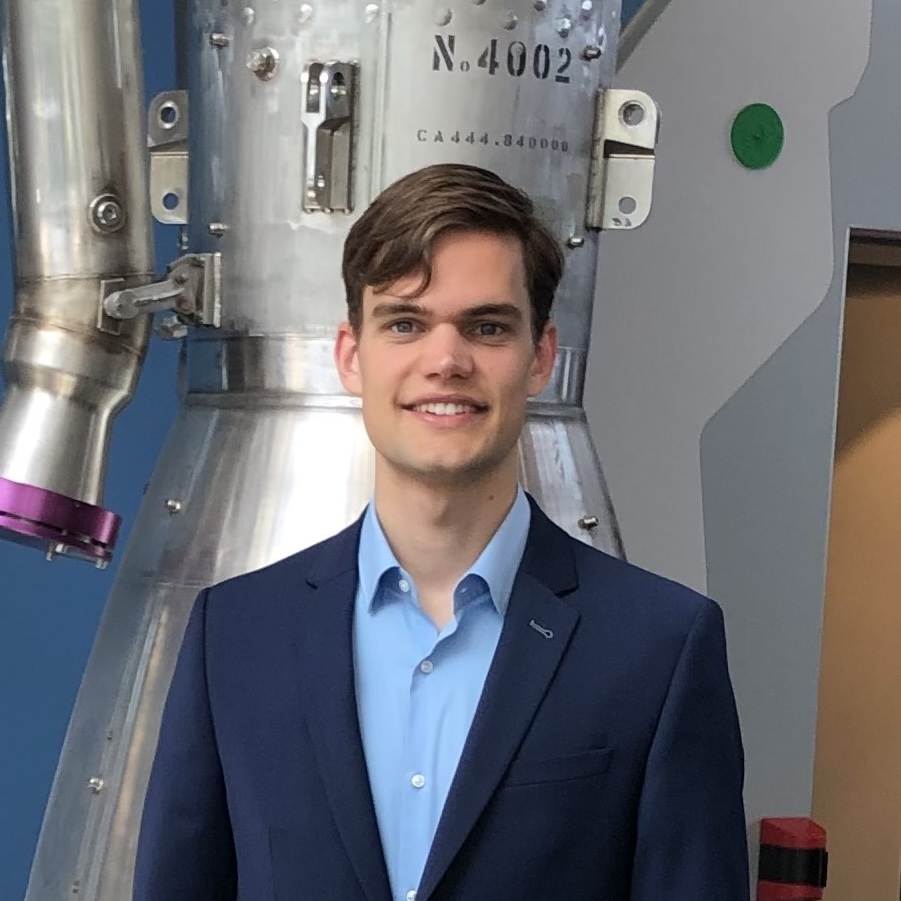
Hugo is a PhD student in the Department of Aeronautics and Astronautics at Stanford University. He completed his BSc degree in Aerospace Engineering at Delft University of Technology in 2022 and his MSc in Aeronautics and Astronautics at Stanford University in 2024. Additionally, he held a research fellow position at Harvard University in the Computational Robotics group directed by professor Heng Yang in 2023. Hugo’s research currently focuses on the control of high-dimensional robotics systems, leveraging both optimal control and novel learning-based architectures, with applications in bio-inspired and soft robotics. He is further interested in autonomy for space missions, and safety analysis of learning-based modules. In his free time, Hugo enjoys watching and playing soccer, reading and traveling.
Abstract: The control of high-dimensional systems, such as soft robots, requires models that faithfully capture complex dynamics while remaining computationally tractable. This work presents a framework that integrates Graph Neural Network (GNN)-based dynamics models with structure-exploiting Model Predictive Control to enable real-time control of high-dimensional systems. By representing the system as a graph with localized interactions, the GNN preserves sparsity, while a tailored condensing algorithm eliminates state variables from the control problem, ensuring efficient computation. The complexity of our condensing algorithm scales linearly with the number of system nodes, and leverages Graphics Processing Unit (GPU) parallelization to achieve real-time performance. The proposed approach is validated in simulation and experimentally on a physical soft robotic trunk. Results show that our method scales to systems with up to 1,000 nodes at 100 Hz in closed-loop, and demonstrates real-time reference tracking on hardware with sub-centimeter accuracy, outperforming baselines by 63.6%. Finally, we show the capability of our method to achieve effective full-body obstacle avoidance.
@inproceedings{EberhardPabonGammelliEtAl2026,
author = {Eberhard, P. B. and Pabon, L. and Gammelli, D. and Buurmeijer, H. and Lahr, A. and Leone, M. and Carron, A. and Pavone, M.},
title = {Graph Neural Model Predictive Control for High-Dimensional Systems},
booktitle = {{Proc. IEEE Conf. on Robotics and Automation}},
year = {2026},
keywords = {pub},
owner = {gammelli},
timestamp = {2026-3-4},
url = {https://arxiv.org/abs/2602.17601}
}
Abstract: Continuum robots exhibit high-dimensional nonlinear dynamics that are tightly coupled to their actuation. This work introduces control-augmented spectral submanifolds (caSSMs), which incorporate control inputs directly into the reduced-order state so the model can capture nonlinear state-input interactions. The approach is trained only on controlled decay trajectories of the actuator-augmented state, removing the separate actuation-calibration step required by earlier SSM-based control methods. On a tendon-driven trunk robot, the learned caSSM enables real-time control, reduces open-loop prediction error by 40% relative to prior methods, and, when combined with model predictive control, lowers closed-loop tracking error by 52% compared with Koopman- and SSM-based MPC baselines, demonstrating practical deployment on hardware.
@inproceedings{WolffBuurmeijerPabonEtAl2026,
author = {Wolff, P. L. and Buurmeijer, H. and Pabon, L. and Alora, J. I. and Leone, M. and Kaundinya, R. S. and Kazemipour, A. and Katzschmann, R. K. and Pavone, M.},
title = {Learning Actuator-Aware Spectral Submanifolds for Precise Control of Continuum Robots},
booktitle = {{Proc. IEEE Conf. on Robotics and Automation}},
year = {2026},
keywords = {pub},
owner = {lpabon},
timestamp = {2026-3-24},
url = {https://arxiv.org/abs/2603.23044}
}
Abstract: Vision-Language-Action Models (VLAs) have shown remarkable progress towards embodied intelligence. While their architecture partially resembles that of Large Language Models (LLMs), VLAs exhibit higher complexity due to their multi-modal inputs/outputs and often hybrid nature of transformer and diffusion heads. This is part of the reason why insights from mechanistic interpretability in LLMs, which explain how the internal model representations relate to their output behavior, do not trivially transfer to VLA counterparts. In this work, we propose to close this gap by introducing and analyzing two main concepts: feature-observability and feature-controllability. In particular, we first study features that are linearly encoded in representation space, and show how they can be observed by means of a linear classifier. Then, we use a minimal linear intervention grounded in optimal control to accurately place internal representations and steer the VLA’s output towards a desired region. Our results show that targeted, lightweight interventions can reliably steer a robot’s behavior while preserving closed-loop capabilities. We demonstrate on different VLA architectures (\pi_0.5 and OpenVLA) through simulation experiments that VLAs possess interpretable internal structure amenable to online adaptation without fine-tuning, enabling real-time alignment with user preferences and task requirements.
@article{BuurmeijerAlonsoEtAl2026,
author = {Buurmeijer, H. and Amo Alonso, C. and Aiden, S. and Pavone, M.},
title = {Observing and Controlling Features in Vision-Language-Action Models},
year = {2026},
journal = {ArXiv 2603.05487},
url = {https://arxiv.org/abs/2603.05487},
keywords = {sub},
owner = {hbuurmei},
timestamp = {2026-02-09}
}
Abstract: High-dimensional nonlinear systems pose considerable challenges for modeling and control across many domains, from fluid mechanics to advanced robotics. Such systems are typically approximated with reduced-order models, which often rely on orthogonal projections, a simplification that may lead to large prediction errors. In this work, we derive optimality of fiber-aligned projections onto spectral submanifolds, preserving the nonlinear geometric structure and minimizing long-term prediction error. We propose a data-driven procedure to learn these projections from trajectories and demonstrate its effectiveness through a 180-dimensional robotic system. Our reduced-order models achieve up to fivefold improvement in trajectory tracking accuracy under model predictive control compared to the state of the art.
@inproceedings{BuurmeijerPabonEtAl2025,
author = {Buurmeijer, H. and Pabon, L. and Alora, J. and Kaudinya, R. and Haller, G. and Pavone, M.},
title = {Taming High-Dimensional Dynamics: Learning Optimal Projections onto Spectral Submanifolds},
booktitle = {{Proc. IEEE Conf. on Decision and Control}},
year = {2025},
month = dec,
address = {Rio de Janeiro, Brazil},
keywords = {press},
note = {In press},
owner = {hbuurmei},
timestamp = {2025-09-18},
url = {https://arxiv.org/abs/2504.03157}
}