
← Back to Team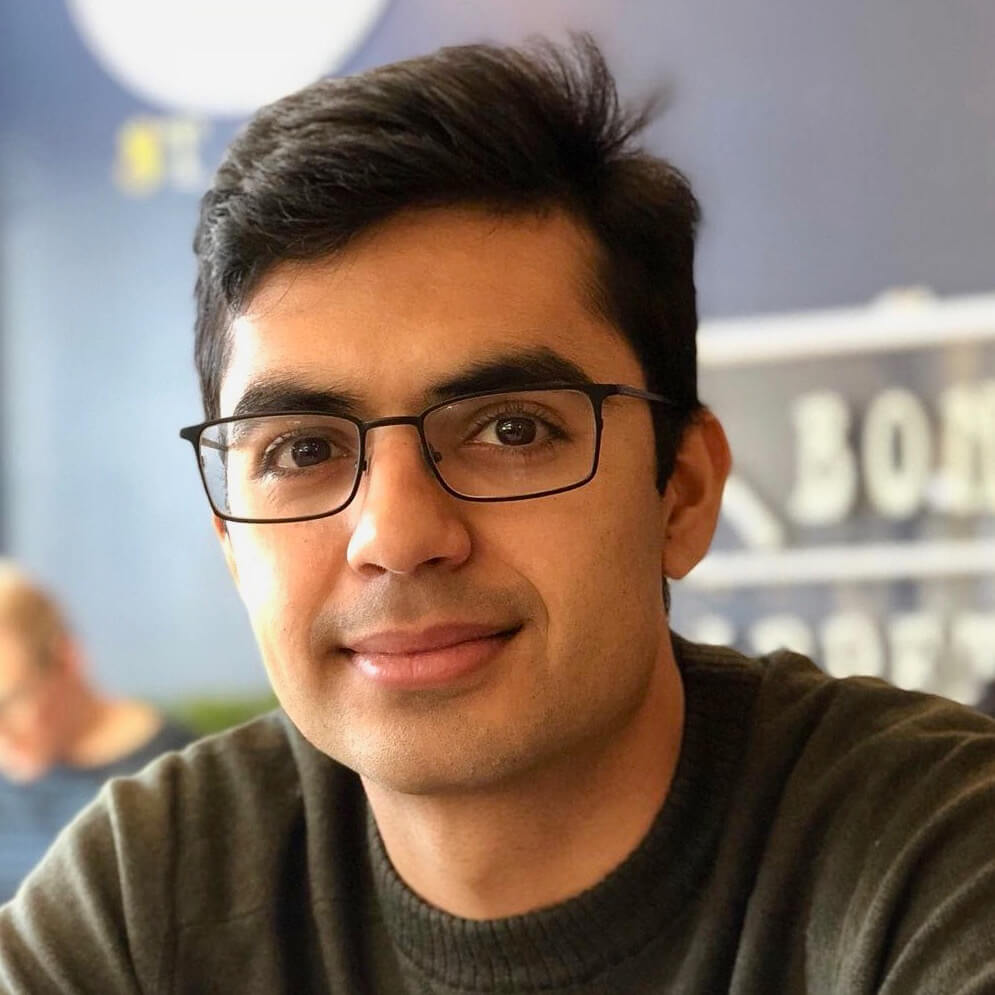
apoorva _at_ stanford _dot_ edu
Apoorva Sharma
Alumni · now at NVIDIA Research
Apoorva Sharma is a graduate student in the Aeronautics and Astronautics department. Prior to studying at Stanford, he received a BS in Engineering at Harvey Mudd College in 2016. At Harvey Mudd College, he worked on trajectory planning for autonomous underwater vehicles under supervision of Professor Chris Clark in the Lab for Autonomous and Intelligent Robotics.
Apoorva's research interests are in the intersection of machine learning, control theory, and planning. His current work focuses on robust and adaptive methods for planning under uncertainty.
Publications
10 publications · full lab bibliography
2022
- A. Sharma, “Methods for Quantifying, Representing, and Utilizing Uncertainty in Learning-Enabled Autonomy,” Ph.D. dissertation, Stanford University, Dept. of Aeronautics and Astronautics, 2022.
- T. Lew, A. Sharma, J. Harrison, A. Bylard, and M. Pavone, “Safe Active Dynamics Learning and Control: A Sequential Exploration-Exploitation Framework,” IEEE Transactions on Robotics, vol. 38, no. 5, pp. 2888--2907, 2022.
2021
- A. Sharma, N. Azizan, and M. Pavone, “Sketching Curvature for Efficient Out-of-Distribution Detection for Deep Neural Networks,” Proc. Conf. on Uncertainty in Artificial Intelligence, 2021.
- R. Dyro, J. Harrison, A. Sharma, and M. Pavone, “Particle MPC for Uncertain and Learning-Based Control,” IEEE/RSJ Int. Conf. on Intelligent Robots & Systems, 2021.
2019
- A. Sharma, J. Harrison, M. Tsao, and M. Pavone, “Robust and Adaptive Planning under Model Uncertainty,” Int. Conf. on Automated Planning and Scheduling, 2019.
- S. Chinchali, A. Sharma, J. Harrison, A. Elhafsi, D. Kang, E. Pergament, E. Cidon, S. Katti, and M. Pavone, “Network Offloading Policies for Cloud Robotics: a Learning-based Approach,” Robotics: Science and Systems, 2019.
- B. Ivanovic, J. Harrison, A. Sharma, M. Chen, and M. Pavone, “BaRC: Backward Reachability Curriculum for Robotic Reinforcement Learning,” Proc. IEEE Conf. on Robotics and Automation, 2019.